By the time senior year rolls around, the question starts to follow you everywhere—in the hallways, classrooms, even quiet moments at home. “What are you going to major in?” At first, it feels simple. A box to check. An answer to give relatives. But behind every response is something much bigger: years of small moments, unexpected influences, and quiet realizations that began long before college applications were due.
For many seniors, choosing a major isn’t just about the future—it’s about looking back at who they were throughout high school, and realizing how much that version of themselves still matters.
Sometimes, it starts in an ordinary classroom. A subject that was supposed to be “just another requirement” turns into something more—something that sticks. Maybe it was a science lab that didn’t feel like work, or an English discussion that made the bell feel like an interruption instead of a relief. These moments often don’t feel life-changing at the time. But later, they become the reason someone chooses one path over another.
For one senior Andrew Poole ‘26 who plans on perusing aeronautical engineering at the Air Force Academy, that interest didn’t come from a single defining class, but from a long-standing curiosity about flight and how things work. “I have always been interested in flight,” he said, “so this seemed like a logical combination.”
Unlike some students, Poole didn’t have early coursework that introduced him to the field. Instead, his interest developed gradually—through independent learning, a few flying lessons, and eventually solidified by taking physics and calculus during senior year. Those classes didn’t spark the interest, but they confirmed it. Outside the classroom, experience played an even bigger role. As a member of the Civil Air Patrol for five years, Poole gained hands-on exposure to aerospace and earned a scholarship to a flight academy, where he soloed in a Cessna.
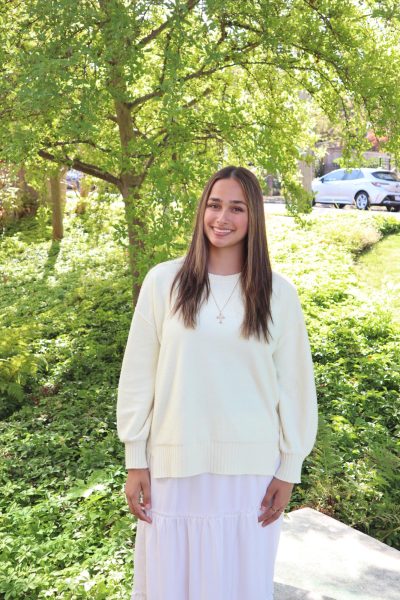
For Senior Ellie Nightengale ‘26, the journey looked different. Now committed to studying Interior Architecture at the University of Tennessee, she traces her decision back to experiences she almost didn’t take.
“I chose this major because I love art and creating things that make impact,” she said. “Interior Architecture focuses on the aesthetics of the build and the emotional impact it makes on the viewer.” But it wasn’t a straight path. After initially considering interior design, Nightengale found clarity through summer programs—first at SCAD in Georgia, then at Columbia University through the NSLC program.
“When I started having fun learning, I knew I picked the correct major for myself,” she said.
“Trying new things can be scary,” she added, “but it will lead you to the most life-changing experiences.” What started as uncertainty turned into something more—along with unexpected connections. She even met her future college roommate at one of those programs.
Behind many decisions is a person who saw something first. A teacher who stayed after class. A coach who pushed a little harder. A mentor who said, “You’re good at this,” before the student fully believed it themselves.
For senior Frank Dixon ‘26, that influence came from both school and home—but especially from the people who supported his passion for golf. “I’ve been very involved in golf for most of my high school life,” he said. Now planning to major in PGA Golf Management and Marketing at Mississippi State, Dixon credits his experience on the golf team—where he served as captain—and mentors like his coaches and teachers for shaping his path.
“I would say that the people who have impacted me are my golf coach, Mr. Meza, Coach Maul, and Mr. Behrman,” he said. Sometimes the right path isn’t found in a classroom at all, but on a course, a field, or in the quiet repetition of something you love.
Not every path is straightforward. In fact, most aren’t. Some students enter high school convinced they know exactly what they want, only to change their minds halfway through. Others discover their interests by accident—joining a club on a whim, taking a class because a friend recommended it, or simply trying something new.
Dixon, for example, didn’t always plan on his current path. “When I was an underclassman, I wanted to do kinesiology or something else,” he said. “But after I found out about professional golf management, I wanted to do it.” Sometimes all it takes is one conversation—or one opportunity—to change everything. There’s something a little funny about it, too, how a random schedule placement or last-minute decision can end up influencing the rest of someone’s life.
For seniors, the excitement of choosing a future is often mixed with pressure. There’s the feeling that this decision has to be perfect. That it has to define everything that comes next.
Dixon acknowledges that pressure—but also pushes back against it. “If you have the luck to be in a position where you can pick what you want to do,” he said, “make the decision based on something you’re passionate about… Don’t listen to people that are trying to sway your decision.”
Looking ahead, each student sees their future as something still unfolding.
Nightengale hopes to work for a firm where she can “create cool things” and explore her creativity. Dixon has long-term goals of becoming a head golf professional—though, as he puts it, he’s focused on “taking it one step at a time.” And for the future Air Force cadet, Poole’s goal is clear but still evolving: to serve as a pilot and continue building on a passion that started years ago.
But if high school teaches anything, it’s that people change. Interests grow. Paths shift. And sometimes, not having everything figured out is part of the process.
By graduation, seniors walk across the stage with more than just a diploma. They carry memories of classrooms, conversations, late-night homework, and moments they didn’t realize were shaping them. Their majors aren’t just choices—they’re stories. Built from years of trial and error, encouragement, doubt, and discovery.
And maybe that’s what makes it all feel a little bittersweet, a little funny, and a little hopeful at the same time. Because while high school is ending, the person it helped shape is just getting started.